The Theory of Narrative Duality
A Tale of Two Christmas Stories
Critics have often noted the striking similarities between Frank Capra’s 1946 film It’s a Wonderful Life and Charles Dickens’s 1843 novella A Christmas Carol. Both are Christmas tales of spiritual crisis and redemption. Both feature a man who, at a critical moment, receives supernatural intervention that transforms his understanding of his own life. Scrooge is shown his past, his present, and a possible future; George Bailey is shown the world as it would have been had he never existed. Through these visions, each man comes to see the value of life anew. Both end in tears and joy, with a moral so clear that even cynics are disarmed.
Some have suggested that It’s a Wonderful Life is simply a modern remake of A Christmas Carol in American dress. Yet though the two stories are clearly related, they are not the same. The central characters, for instance, could hardly be more different. George Bailey is a generous and selfless man, loved by his community and indispensable to it. Scrooge is a miserly loner, cut off from human companionship.
Yet the two stories stir uncannily similar emotions in us. They feel very much the same. True, there are differences in tone. Capra, as in all his films, avoids sentimental excess by undermining sweetness with cynicism. This edge is absent from Dickens. Scrooge is cynical; Dickens is not. Dickens does tend towards sentimental excess. His Cratchits are a shade too good to be true, and Tiny Tim positively glows with virtue. But his villains are iconic. Scrooge is a perfect example.
Here Dickens offers something that Capra does not. As the writer Robertson Davies has pointed out, Dickens lets us have our cake and eat it. The miserly Scrooge of the opening chapters is wicked, yet also rather delightful. As Davies put it, ‘We love Scrooge in both his phases.’ Capra’s George Bailey offers no such pleasure. He begins good, kind, and self-sacrificing, and his suffering is simply painful to watch. James Stewart’s everyman decency makes his anguish hard to bear, whether in Vertigo or in It’s a Wonderful Life.
Yet, despite these differences, there is an undeniable sense that we have been through the same kind of emotional journey. So what exactly is the relationship between these two stories? If their central characters are so starkly different, why do they feel so similar? Certainly there is the Christmas setting, and the heavenly visitors who show each man his life from a different angle. But it’s more than that. They share a structure, certainly, but they also seem to exist in some kind of mirror relation to each other.
To understand why, we must look in a most unlikely direction: mathematics.
A Brief Excursion into Geometry
Stay with me here; we are about to wander into an odd borderland between mathematics and linguistics, where theorems give way to word games.
Hidden within geometry is a curious little principle that behaves as though it were animated by a kind of linguistic alchemy. It is called duality, and it works like this.
You take a statement from geometry, the sort of thing we all met in school, and you systematically swap certain words for their geometric partners. Point becomes line; line becomes point, for instance. Then you tidy up the grammar so the sentence still makes sense, and, lo and behold, the transformed statement will also be true.
Surely this shouldn’t work, should it? In a field that prides itself on meticulous, almost fussy, accuracy, you cannot mess around with its statements like this and expect truth to remain intact. It feels like cheating, and yet the trick works every time.
For example, the statement ‘Two points determine a line’ has the dual ‘Two lines determine a point.’
Indeed they do: the point at which they intersect.
A slightly more complex case:
“Three non-collinear points define a unique triangle.” Dual: “Three non-concurrent lines define a unique triangle.”
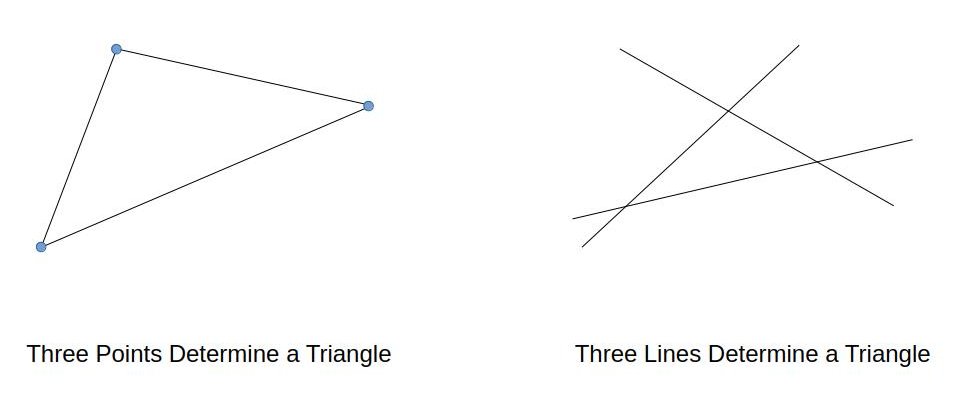
Geometric Duality
You exchange point with line, along with the corresponding properties; collinear means points lying on the same straight line; concurrent means lines that meet at the same point.
But it works not merely with trivial statements; it works with full-blown theorems, turning them inside out to reveal new and equally valid truths.
Blaise Pascal, when he was only sixteen, proved a theorem that now bears his name:
Pascal’s Theorem: If six points lie on a circle or ellipse and we join them to form an internal hexagon, then the three points where the opposite sides intersect lie on a single straight line (are collinear).
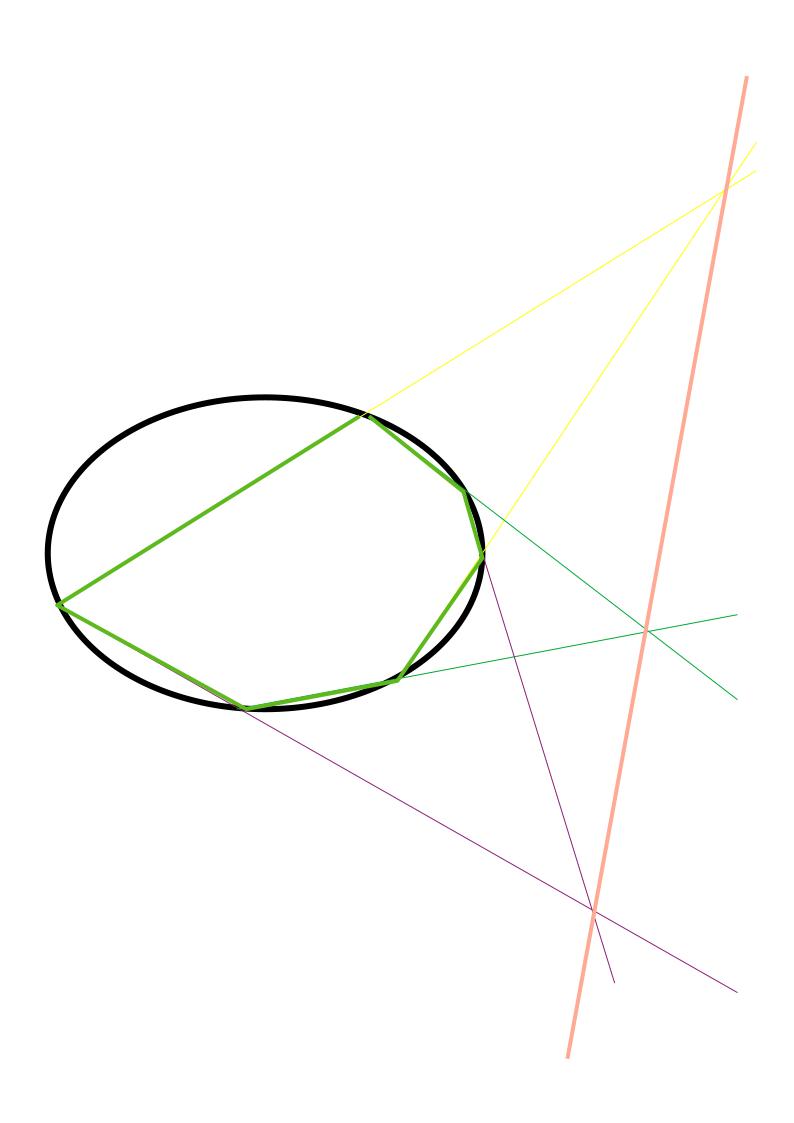
Pascal’s Theorem
That line is called the Pascal line.
Now apply our ’linguistic’ transformation, swapping points for lines, sides for vertices, collinear for concurrent, and we get:
Brianchon’s Theorem: If six lines touch a circle or ellipse to make an external hexagon, then the three lines joining opposite vertices (the diagonals) are concurrent.
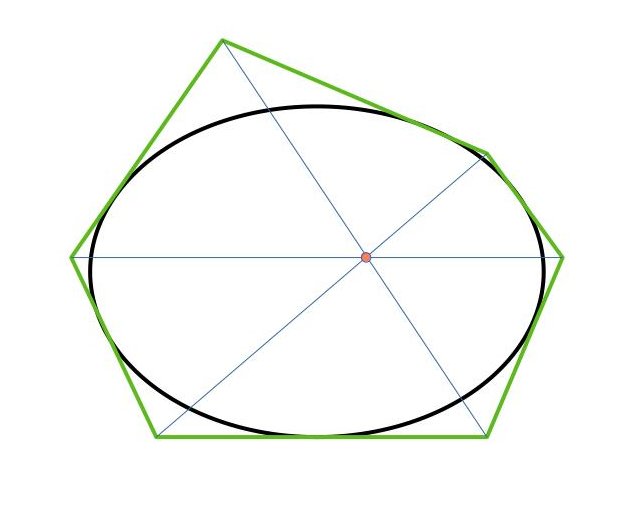
Brianchon’s Theorem
The point where they meet is called the Brianchon point.
Both theorems are true. Both concern ellipses and hexagons, but they are wildly different statements, as the diagrams probably make clear. Better still, Brianchon’s theorem is actually quite tricky to prove directly, but once you have proved Pascal’s theorem, you obtain Brianchon’s for free. Most geometry textbooks don’t even bother with a separate proof.
The whole mechanism strikes me as rather wonderful.
Perhaps we ought not to be surprised. Language and mathematics have long been intertwined. The Sanskrit grammarian Pāṇini used the the concept of zero as a grammatical operator in his linguistic system two and a half millennia ago, paving the way for its use in mathematics.
If language seems to have come to the aid of mathematics, let us now see how mathematics might return the favour.
The Dickens–Capra Duality
Look again at our two Christmas stories. They are not the same, nor are they opposites. They are, I suggest, duals of each other, in the mathematical sense.
Take A Christmas Carol and apply the duality procedure:
- Scrooge is wicked; make him virtuous.
- He is wealthy; make him poor.
- He is content; make him desperate.
- He is shown what is and what will be; show him what might have been but is not.
- It is the vision of the future that changes his mind; make it a vision of the present that does so.
- He is persuaded to change; let him be persuaded to remain unchanged.
Make these substitutions, and what you get is It’s a Wonderful Life.
It is as though Dickens’s narrative has been transformed into its dual by a species of geometrical alchemy. The underlying logic remains the same, just as Pascal’s and Brianchon’s theorems both concern ellipses and hexagons. Both stories concern supernatural intervention redeeming a man through visions. But the moral terms have been neatly inverted: points become lines, virtue becomes vice.
Emboldened by this little mathematical detour, and in the spirit of academic overreach, I’d like to propose a modest theory of narrative duality.
Towards a Theory of Narrative Duality
In true mathematical fashion, we begin with a lemma:
Lemma 1:
Just as geometry has points and lines that can be swapped, stories have what we might call narrative elements that can be inverted: virtue/vice; ignorance/knowledge; despair/hope; change/stasis; past/future.
(The proof is obvious.)
With this lemma established, we may now prove:
Theorem (The Fundamental Theorem of Narrative Duality):
If a story is sufficiently well plotted, if its internal logic holds together with something like the force of a theorem, then we may, through a judicious choice of narrative elements, swap those elements with their inverses and obtain a new, coherent, and compelling narrative. The result will not be the same story, but its dual: a mirror image whose emotional logic remains valid even though its values are reversed.
Proof is by example.
This opens up intriguing possibilities. Could we use this method to generate new stories from classic plots? Have we discovered a literary philosopher’s stone? After all, if George Lucas could build a multi-billion-dollar franchise on Joseph Campbell’s Hero’s Journey schema, perhaps there’s money to be made here. (But now I am sounding like Scrooge.)
Caveats and Speculations
Alas, this is not a mechanical procedure. In geometry, duality is guaranteed: if one theorem is true, its dual must also be true. But narrative duality offers no such certainty. You cannot simply feed a story into an algorithmic inverter and expect a good narrative to emerge.
My own attempts to apply this method to various classic works (including Shakespeare’s The Tempest) have demonstrated rather forcibly that narrative craft requires more than structural inversion. My results were more like turning gold into base metal.
Beyond these practical failures, there is a theoretical problem: not all stories are equally dualisable. The dual of Hamlet might be a story about a prince who does not hesitate, but that is just a standard revenge tragedy. In other cases, the dual might already exist and turn out to be rather dull. The theory works best, I suspect, with stories that have a certain abstract quality, a clear moral geometry.
Even when a story is dualisable, the choice of what to invert matters enormously: there are multiple ways to dualise any given story, depending on which narrative elements you choose to swap.
But if the theory holds, there may be other literary duals waiting to be discovered or written. Might Dr Jekyll and Mr Hyde and The Picture of Dorian Gray be narrative duals of each other? Pride and Prejudice and Wuthering Heights? Could The Odyssey have a dual waiting to be written? I leave it to more gifted writers than myself to find out.
I offer the theory freely, but should anyone make a fortune from it, I claim ten per cent of the royalties.
November 2025