Rethinking the Andromeda Paradox
What a Famous Paradox Can Teach Us About Time
1. Introduction
This essay is the first in the Block Universe Series, which explores what relativity really tells us about time. Here we look at a well-known thought experiment in relativity — the Andromeda paradox. This popular version of the block universe argument was introduced by Roger Penrose and is sketched in this short BBC video. Here I show that the reasoning from this “paradox” to the block universe dissolves once we look closely at what the physics actually says.
This essay is written for a general reader, with optional explainer pieces for those who want more of the physics, and later essays that take on the more philosophical versions of the argument. All of these are linked from the series page, and from the glossary at the end of this essay.
We’ll begin with a quick sketch of how relativity changes our picture of time, especially the relativity of simultaneity, which is central to the block universe idea, before outlining the Andromeda argument and showing where it goes wrong.
2. From Universal Now to Relative Nows
Most of us have a simple idea of time:
-
The universe unfolds through time with a moment, ’now’, which is universal. The same everywhere and for everyone.
-
‘Behind’ now lies the past, which has already happened, and ahead of it lies the future, which has not yet happened.
Diagram 1 captures this naive idea of time in picture form.
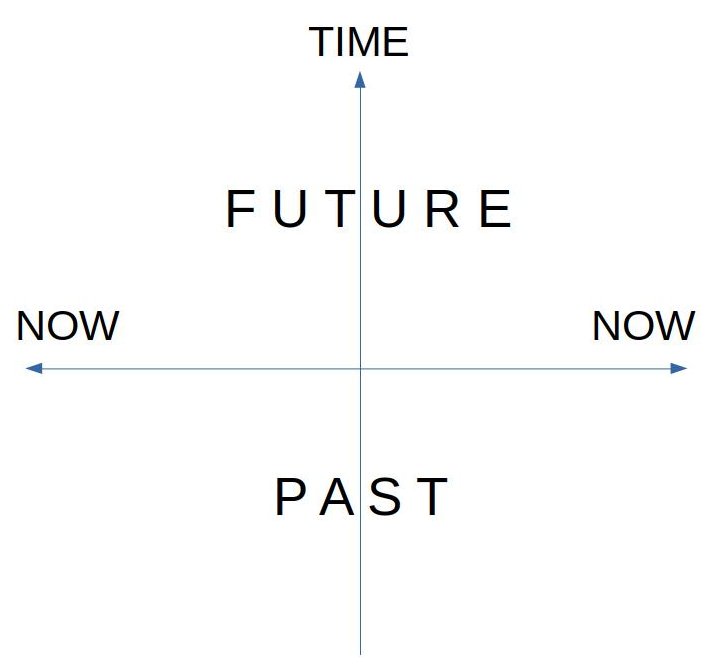
Diagram 1: Naive View of Space and Time
Each point on the Diagram marks an event - something happening at a place and an instant. The line going across the page represents all the events that are happening now.
This is in fact a naive version of what is known as a spacetime diagram in relativity theory. But the theory tells us three important things that force us to change this picture:
-
Nothing can travel faster than the speed of light. c for short
-
Light always travels at this same speed relative to all observers, no matter how those observers are moving relative to each other.
-
People moving relative to one another will disagree about which distant events are happening now. There is no single, global ‘now’.
This last point is called the relativity of simultaneity, and we’ll explain exactly what it means in the next section.
These facts combine to give us a new picture:
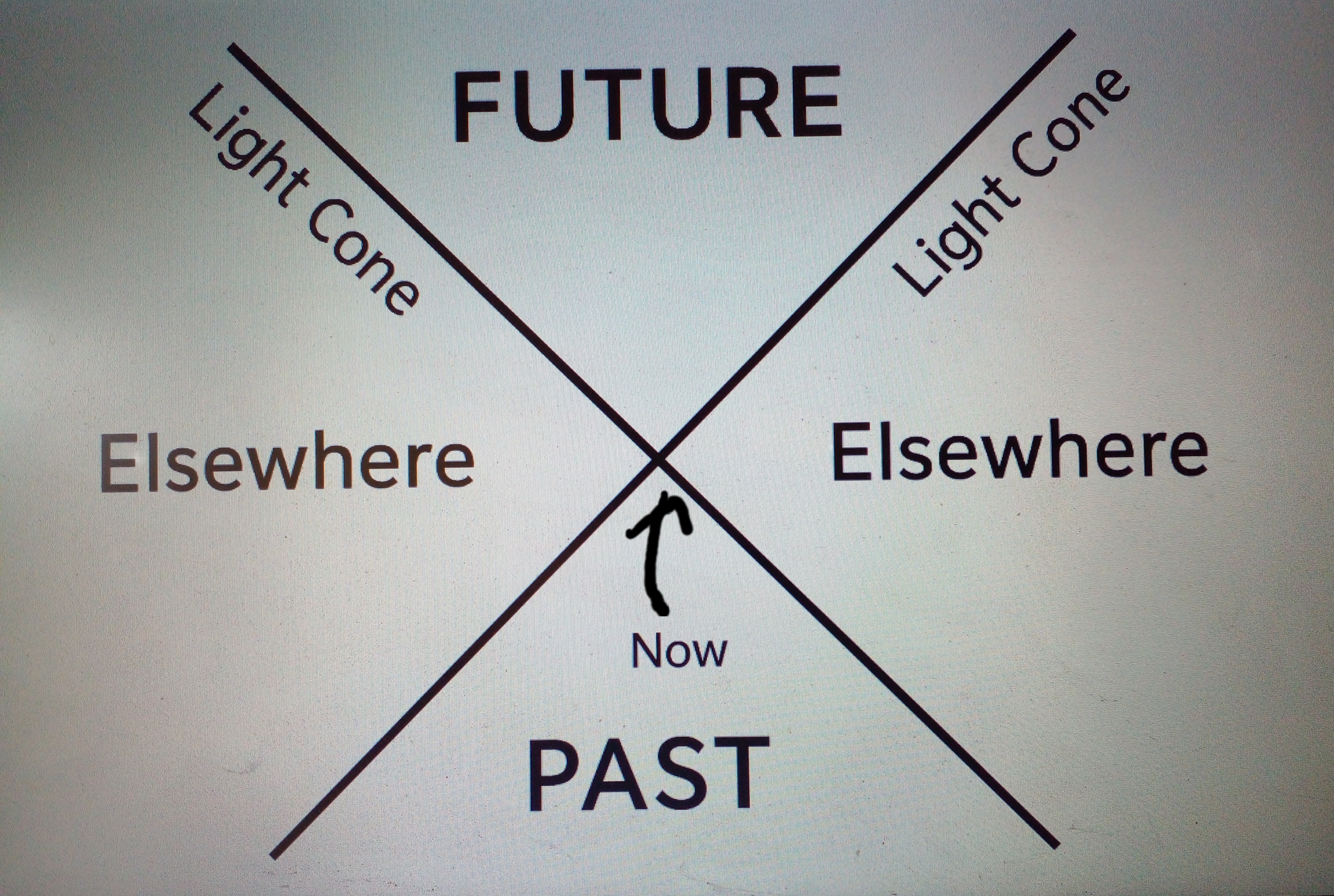
Diagram 2: Spacetime
Notice the following important differences from Diagram 1 (the naive picture):
- The past is now confined to just the bottom quadrant, and the future to the top.
- Since there is no universal ’now’, the line in Diagram 1 is gone, and ’now’ is reduced to only the point at the centre - where we are here and now.
The other labels are best explained by showing a ‘3-D’ version of Diagram 2, showing not just one but two dimensions of space.
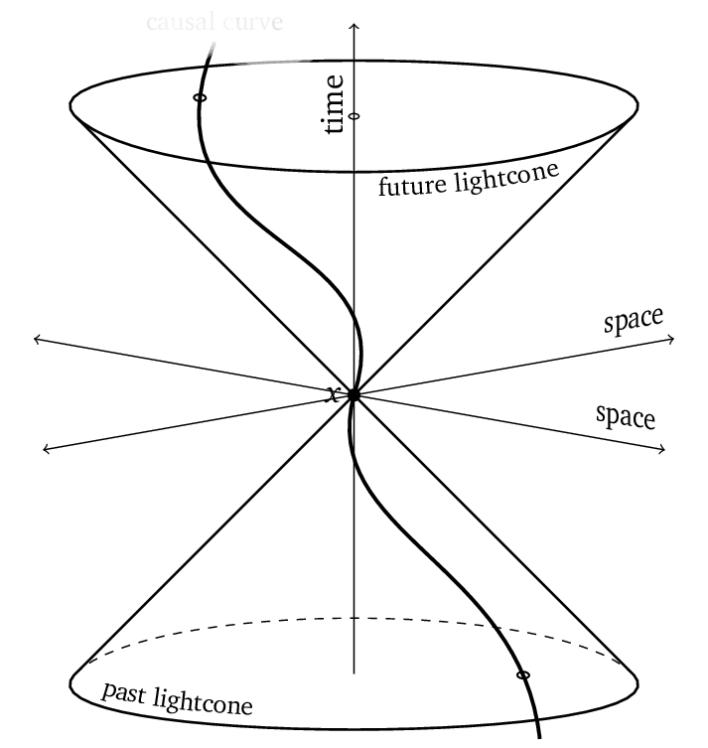
Diagram 3: A 3-D Spacetime Diagram.
The most striking features are the two light cones. The name light cone is used because the cones are the trajectories of rays of light. Everything outside of the light cones is simply called Elsewhere. The upper cone ‘contains’ the future and the lower cone ‘contains’ the past. Diagram 2 is essentially a vertical cross-section of Diagram 3, so the cones appear as straight lines, and the ‘Elsewhere’ region appears in two parts on the left and right.
So why this picture? It comes down to the limit set by the speed of light. The only events that a person at the centre (x) can possibly reach, or which could be reached by a signal sent from x, are those which lie inside the future light cone. So these events comprise their possible future. Likewise, the past light cone contains all the events that a person at x could have come from.
Events outside those cones, in the so‑called ‘Elsewhere’ region, can have no causal connection to x because neither can affect the other without faster‑than‑light travel, which relativity tells us is impossible.
Going back to the three points I mentioned above:
- Nothing can travel faster than light.
This is why the light cones are important. They distinguish events that can affect each other from ones that can’t.
- Light travels at this same speed relative to all observers.
This is why the light cones are in the same place for everyone. Their boundaries are absolute, agreed upon by all observers, regardless of how they’re moving. And that’s why we are able to draw them in as a fixed feature of spacetime.
- The relativity of simultaneity.
This is why we can’t draw in the line for ’now’ in the same way we drew the light cones. Because that line isn’t the same for everyone, observers can’t agree on where it should be drawn. (We’ll explain why in the next section, and more fully in the explainer essays.) But they can each draw their own version, as we will see.
Understanding just what this relativity of simultaneity means is crucial to following the Andromeda argument, and seeing where it goes wrong. So we’ll explain that next, before setting out the Andromeda paradox itself.
3. The Relativity of Simultaneity
The relativity of simultaneity is one of those aspects of relativity that give it its reputation for weirdness, and it’s the one most central to the block universe argument. To understand how this comes about is somewhat involved, which is why I have left the full explanation to the explainer essays.
Here, I will give just a sketch of how this comes about. What is important here is that you understand what it means, what it implies, and that it is real. This isn’t a controversial claim within physics.
It is a consequence of another principle of relativity, but a very straightforward one. In fact, it’s known as the principle of relativity, and it goes all the way back to Galileo. It is the principle that any steadily moving observer can legitimately consider themselves to be stationary.
Think of travelling on an aeroplane or a smoothly moving train, or car. It feels the same as standing still. That is the principle of relativity.
We usually think of the Earth as standing still, with us moving about on it, but we know that the Earth itself is moving relative to the sun, and the sun relative to the centre of our galaxy, and so on. On a universal scale there is no fixed reference point so, for the purpose of making calculations, anyone is entitled to consider themselves to be stationary. As long as they are not changing their velocity, but simply moving steadily in a straight line.
Now think about how we know what is happening at this moment a long way away, such as in the Andromeda galaxy. Well, we can’t know. But we can work out later what was happening at this moment, by making calculations based on signals - usually light signals - coming from there, taking into account the time it took for the light to reach us.
So the speed of light comes into our calculations, and our current distance from Andromeda. But each observer counts themselves as being stationary. And each of them also sees those light signals pass them at the same speed. So they will get different answers to their calculations. This is why they disagree on what is ’now’ elsewhere. This is the relativity of simultaneity.
We can picture the result of all this on a spacetime diagram. Imagine two people – let’s call them Mike and Melissa – passing each other in the street. At the instant they meet, they’re at the same location, but moving differently: say Mike is walking north and Melissa is walking south. This situation is illustrated in Diagram 4.
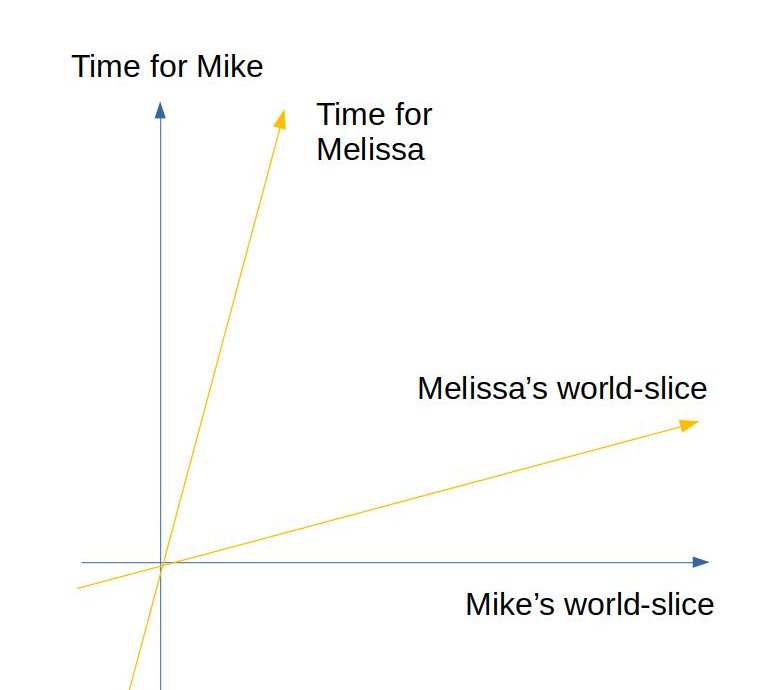
Diagram 4: The Relativity of Simultaneity
The picture is drawn from Mike’s perspective. So his world-line is drawn straight up the diagram, since for the purposes of calculations, he thinks of himself as stationary. His ‘world-slice’ is the set of all the events that Mike judges to be happening now, based on those calculations. It’s his version of the ‘NOW’ line in Diagram 1, except that instead of one slice which everyone agrees on, everyone has their own slice, and they are ’tilted’ relative to each other. They cut in different directions.
The key point is this: all of these different ’nows’ are equally valid. The principle of relativity tells us that none is ’the right one’. Melissa’s world-slice is just as legitimate as Mike’s.
This structure reveals an important distinction. When we talk about our ‘past’ or ‘future’, we might mean two different things:
What physicists call the absolute past and future: events inside our light cones that can causally affect us or be affected by us. We’ve labelled these regions simply ‘past’ and ‘future’ in Diagram 2, following standard physics practice.
Or, what I shall call for now the relative past and future: events outside the light cones but behind or ahead of our world-slice - what we’d judge to have ‘already happened’ or ’not yet happened’ based on our reference frame.
It’s the second sense - the relative past - that proponents of the block universe rely on when they say an event is ‘in the past’. But unlike the absolute past, events in the relative past cannot causally affect us.
With this understanding of how Mike and Melissa can have different but equally valid views about what’s happening ’now’ in Andromeda, we’re ready to look at Penrose’s thought experiment.
4. The Andromeda Paradox Explained
Roger Penrose’s Andromeda thought-experiment makes these ideas dramatic. As we’ve just seen, Mike and Melissa pass each other in the street, moving in different directions. Special relativity says they will disagree about which remote events are simultaneous with the instant they meet.
Penrose asks us to imagine an alien council in the Andromeda galaxy, deciding whether to launch an invasion fleet towards Earth. In one observer’s reference frame (Mike’s), the decisive vote happens tomorrow; in the other observer’s frame (Melissa’s), the vote happened yesterday. According to this story, at the moment they pass each other, Mike would call the fleet’s launch a future possibility, while Melissa would call it a past fact. Diagram 5 gives a sketch of how this comes about, given Mike’s and Melissa’s different world-slices.
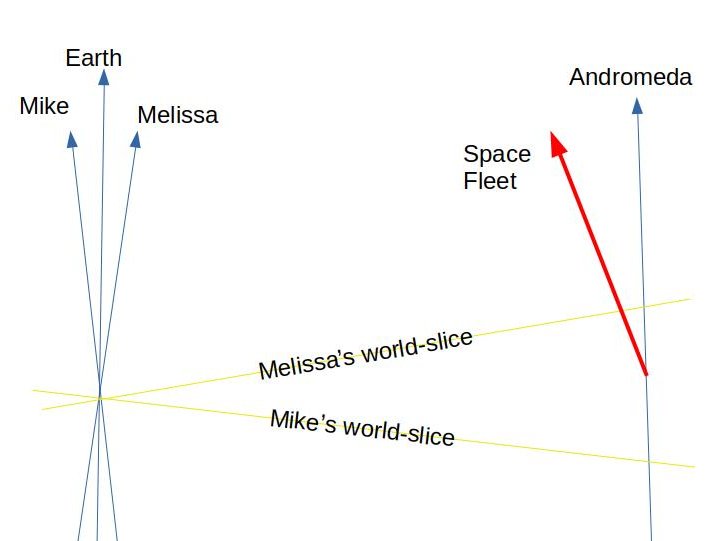
Diagram 5: Invasion from Andromeda!
The intuitive leap: We all know the past is fixed, and since Melissa’s ‘past’ contains what is, for Mike, a ‘future’ event, then Mike’s future is already fixed. Extend that reasoning everywhere and you end up with the block universe: all of spacetime is already fixed.
5. Where the Andromeda Argument Goes Astray
It’s an intriguing argument, and it’s persuaded many thoughtful people. But there’s a flaw hidden in what seems like straightforward reasoning. To find it, we need to examine the argument step by step.
I’m going to lay the Andromeda argument out as a series of seven very short steps. This may look like overkill, but it’s deliberate. The flaw hides in what feels like a natural step of reasoning, and we’ll only catch it by slowing right down.
1. Mike and Melissa meet at the same place, but because they move differently they have different world-slices - True
2. The launch of the fleet lies on, or just before, Melissa’s current world-slice - True
3. The launch will not lie on Mike’s world-slice until tomorrow - True
Comment: There’s nothing at all wrong with these three statements. They are exactly what relativity tells us about how simultaneity depends on motion, as shown in Diagram 5.
4. In other words the launch, which is in the future for Mike, lies in the past for Melissa - True
Comment: True, provided we remember that we are talking about the relative, not the absolute, past and future.
5. We can restate this: “Mike’s future is Melissa’s past.”
Comment: Here’s where the reasoning begins to slip. Not all of Mike’s future is the past for Melissa - not even all of his relative future. And none of his absolute future lies in Melissa’s past. We could say that some events in Mike’s future are already in Melissa’s past - but only in the relative sense.
6. But since the past cannot be influenced, then the future cannot be influenced either.
Comment: We can accept a limited version of that: some future events can’t be influenced.
Which ones? Just those that lie “ahead” of Mike’s current world-slice but behind Melissa’s, and therefore outside Mike’s future light cone.
But we already knew that.
We explained it earlier, and without bringing Melissa into it at all. As we saw in section 2, no one can influence any event outside their light cone. This fact has nothing to do with predetermination - it simply reflects the finite speed of light, the ultimate limit on causal influence.
7. Since the future cannot be influenced, then it is already fixed.
Comment: This final step no longer follows. The immunity of some events to our influence doesn’t mean they already exist in the way the past does; it just means they’re too far away for any signal to reach them.
This side-by-side picture illustrates this starkly:
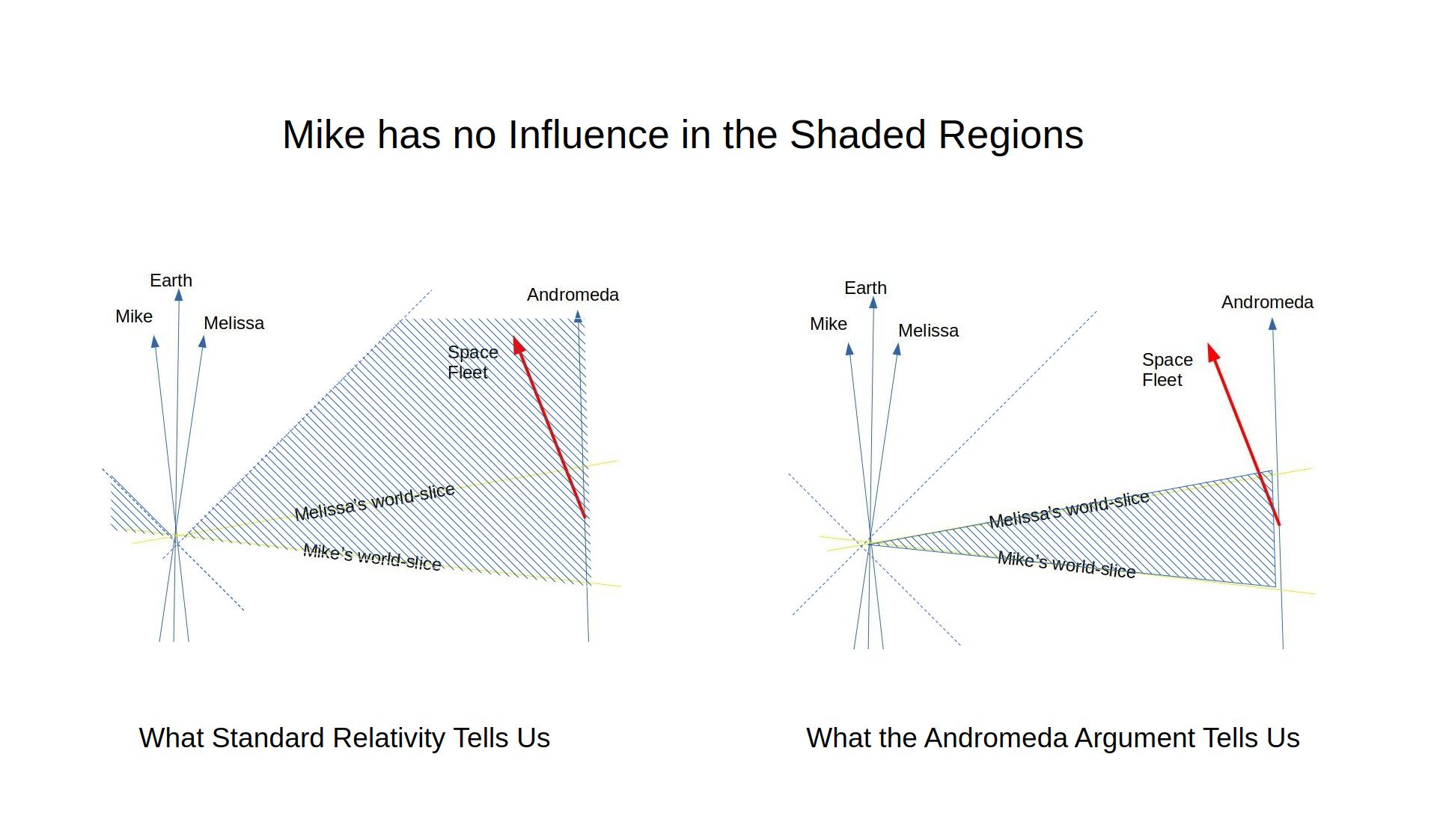
Diagram 6: The Andromeda Argument Tells us Nothing New
The whole “two-observers” set-up turns out to have been a red herring: it dresses up a simple geometric fact as if it were a deep truth about destiny.
It’s like sending Chrustmas cards. If, come December 20th, you realise that now your cards can’t possibly arrive on time, you don’t lament that you have no free will - you know it’s simply that you left it too late.
Relativity tells us the same sort of thing: it sets limits to what we can influence, but doesn’t tell us the future is carved in stone.
6. Where This Leaves Us
Relativity theory is about changing the coordinates we use to label events. It also imposes strict limits on cause and effect via the light cones. But it does not, by itself, show that the course of events is fixed in the philosophical sense of predetermination.
Have we demolished the block universe idea? Not quite. The Andromeda argument is a simplified version, and more sophisticated ones remain, which I’ll take up in Part 2. Yet however they’re framed, they rely on the same misconceptions.
The four-dimensional picture of the world belongs to physics. The block universe belongs to metaphysics.
Glossary
Most entries have links to in depth explanations in the companion essays.
Event. A point in spacetime (where and when something happens).
Reference frame. A choice of coordinates for referring to places, times, and events. in depth
c. The velocity of light, which is the same for all observers.
in depth
Relativity of Simultaneity. Which events are simultaneous is not an absolute fact, but depends upon the reference frame being used to describe them. in depth
World‑slice. The set of events an observer calls ‘simultaneous’ with a chosen local event.
Light cone. The set of events reachable by light signals from a given event (future cone) or which could have sent light to it (past cone).
Elsewhere. The region of spacetime outside the light cones.
Absolute past/future. Events lying inside our past/future light cones, which we can influence or be influenced by. in depth
Relative past/future. Events lying behind/ahead of our world-slice, but outside our past/future light cones, with which we can have no causal connection. in depth
Predetermination. The belief that the future is already fixed or “exists in advance.” Unlike determinism, it is a metaphysical claim about fate, not a physical claim about causation.
Spacetime Diagram. Essentially a distance/time graph like the ones we learn in school, but with time going up the page instead of to the right, and with features drawn from relativity theory.
Oct 2025 - Revised Nov 2025